

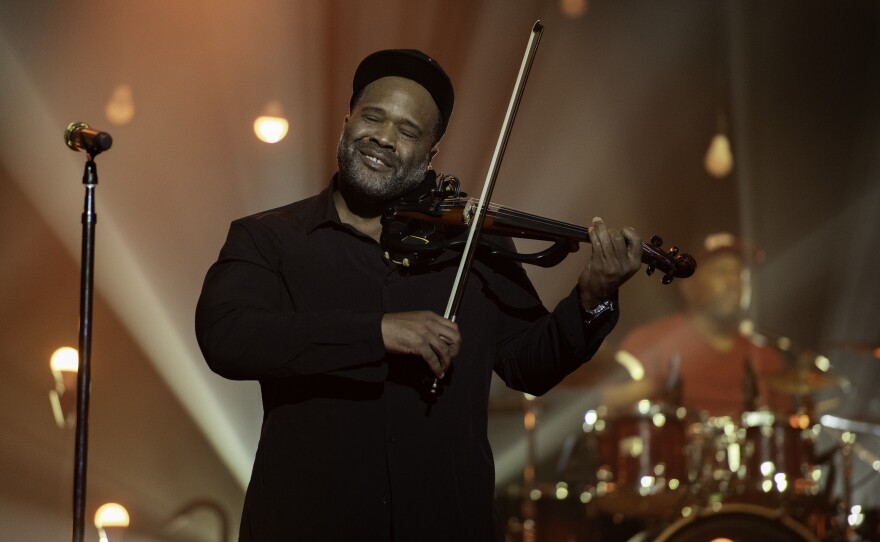
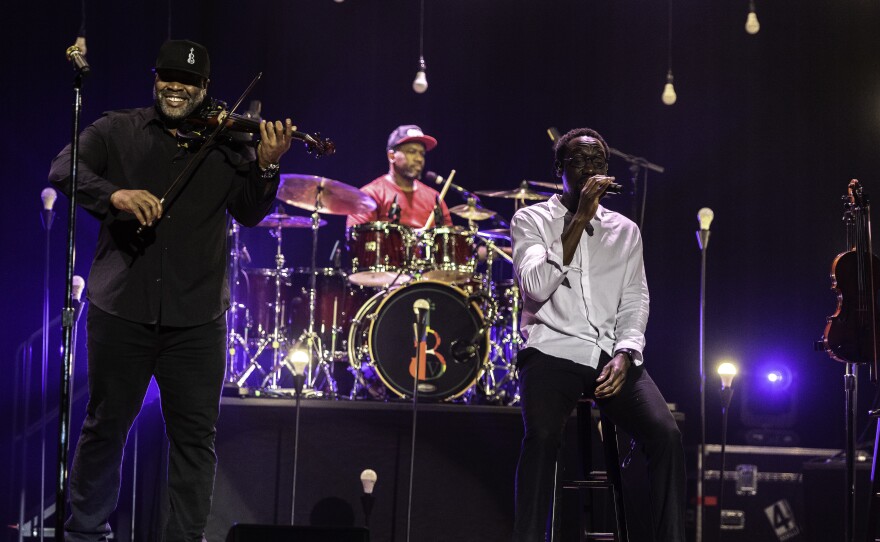
Kev Marcus of the Grammy-nominated duo Black Violin joins WBOI’s Brianna Barrow to discuss the meaning behind their new album Full Circle, their mission to challenge expectations through music, and their foundation’s impact on young musicians ahead of their Feb. 12 performance at The Clyde Theatre.
Brianna Datta-Barrow: I'm joined now by Kev Marcus, part of the duo of Black Violin. Thank you so much for being here. Mr. Marcus.
Kev Marcus: Thank you for having me.
Brianna Datta-Barrow: Let's start off by talking about you and Mr. Will Baptiste’s new album, Full Circle. Could you tell us about the meaning behind the title?
Kev Marcus: So, the title Full Circle is, you know, it represents twenty years of us recording music, and when we're making this album, it's our sixth album, when we were recording it, it started to feel like some songs were sort of like graduated versions of songs from our very first album. So it's almost like we're running a lap, and then it felt like we're starting back at the at the beginning again, but with a little bit more intentionality, and, you know, some other and it just like the sound is a little bit more graduated, but it was still kind of the same, same thing, you know.
So, it started to feel like, while we're creating the album, it just started to feel like each song was doing that, and they were like, oh, we're coming full circle on these concepts, so to speak, twenty years later. So, we decided to name our album Full Circle, and then, you know, kind of theme our tour in that same way, just, you know, educating our fans and showing them the twenty years and kind of where we started and now where we are.
Brianna Datta-Barrow: I love that, and I love the album. It's incredible. I was listening to Beautiful Day on my way to work today.
Kev Marcus: I love that song that's one of my favorites. Thank you so much.
Brianna Datta-Barrow: So, your sound blends classical music with hip-hop and modern beats. Why is that fusion still so important to your mission after nearly twenty years?
Kev Marcus: I think it's because it's a bit disruptive, you know? I think we try to be really, we want to be really palatable and give you everything that you're used to- whether it's pop music or classic music. But we also kind of want to disrupt what you thought was possible too, and though that medium has always been great for us, because we know how to do it on both sides, where we're very intentional about making sure we are respectful of both sides, you know, whether it be hip hop or whether it be the classical side. So I think that's the sweet spot for us, is that we're disruptive, but we're also respectful.
Brianna Datta-Barrow: Yeah, and you kind of challenge that, you're looking for a challenge, like with the song Smoke- just the coolest sound. It's like nothing I've heard before.
Kev Marcus: Yeah, but it's like nothing that you've heard, but it feels like it, it's something you… It's like you've something you've been looking for. It's like this interesting space to try to make, to create, where, you know, we want to be something you've never heard, but we want you to gravitate to it quickly, as if it's like, it's familiar to you in some way. So, it's a bit of a trick to try to be familiar and very, very different all at the same time.
Brianna Datta-Barrow: Yeah, I love your sound. So, you and Will met as high school orchestra classmates I read. So, when you guys look back at, you know, those versions of yourselves, what do you think that they would be most proud of today?
Kev Marcus: That we're pretty much the same guys that we were then. We haven't really changed much. I think they'd be proud of the sort of disruptive nature of it. And I kind of feel like, you know, we kind of feel it a little because we played in this in an orchestra that was really good.

We're all really good, and just sort of this beautiful storm that happened, and we see all of those members from that orchestra twenty years later at different shows all over the country. So, we kind of get that mirror where they're like, man, it's like Dillard High School on a stage, you know. And so I would think that, you know, we would be most proud of that we didn't change, and we remain true, and we allowed, sort of, like, our roots, and that the sound that we created in high school, we allowed it to permeate through the whole world.
And, you know, now we have a Wikipedia page, and you know, Grammy nominations off of something we learned in high school, you know? So, I think that that's probably what we will be most proud of.
Brianna Datta-Barrow: Yeah, congratulations on the Grammy nomination as well. That's amazing. That's so cool. And, yeah, I love, I love that, that you just stay true to yourselves after all the success. I would also love to talk about your Black Violin foundation. I got really moved reading about it. I just think it's so cool that you guys are giving access to kids from communities like the ones that you grew up in. So, what does that mean to you?
Kev Marcus: Yeah, I mean, that's kind of everything, you know? I think that the thing that will live well beyond Black Violin is the foundation that we built. You know, where we have, we have so many different programs.
One is here in South Florida, where we're putting, you know, we're putting, we're doing classes. There's a lot of schools that are not taking, not offering string programs anymore. So, we created an after-school situation all throughout South Florida where we have, you know, over sixty kids enrolled in string programs and after school programs. And we're going to have a big festival in June here in South Florida, where they'll all be able to come on stage and perform what they learned. So, it's just a really cool, you know, situation that we're building, and we're really, really just proud of it.
And then nationally, we just had the James Miles Musical Innovation Grant. It's a grant that's named after our high school teacher that connected a lot of dots for us when we were young. Yeah, and now we do the same, and the grant program just closed, but, you know, we had over one hundred applicants of young students that we awarded up to five thousand dollars based on, you know, anything. I mean, it could be they want a new violin, or private lessons, or they need a laptop to make beats, or whatever it is. It's all just sort of, you know, based on whatever they're trying to do. And it's a grant, it's up to five grand, and it's for young kids from twelve to twenty. That's already in violin, it's already kind of planned, and just needs help connecting that.
So, we have a lot of different things, and you know, that support us and say, you know, check us out. Maybe apply for the grant program. You can check us out at blackviolinfoundation.org.
Brianna Datta-Barrow: Man, that is something to be proud of, for sure. That's so cool that you guys do that. You talk about challenging stereotypes of what a classical musician looks like and sounds like. Could you talk about why that representation is so powerful, especially for young, low-income musicians?
Kev Marcus: Well, I mean, I think that in general, is powerful. I mean, I love playing violin, but, you know, the thing that really kind of stuck to me about it was when I was in high school, and I had a girlfriend in high school, and I remember, you know, meeting her father, and it was like, Who is this guy? And I'm like, oh, you know, I just came back from my audition for Juilliard, and I'm just a little nervous. I hope I made it like, Julliard, what do you do? I'm like, Oh, I'm a classically trained violinist. You play the violin? And it's just like, his guard came totally down.
And similarly, I had a job interview when I was 16, and same kind of thing. It's like, Hey, I could start the job, but I can't start next week because I have an audition at Northwestern in Chicago. And if you're like, Oh, what do you do? I'm a violinist. You play the violin? Okay, as soon as you get back, you're hired, you know? And it was like, wow. Like, I didn't even have to play for you. It's just the idea of me playing was something that changed people's perception of me and then when I played, they were like, wow, this guy's really good. So I was like, wow. Okay.
So that, to me, was always the reason why that's been, the reason why I play ever since then, is that I play violin- because I'm not supposed to.
And then somewhere along the line through college, it's like that that became like, well, okay, well, what is someone playing violin that's not supposed to sound like? You know? And that's what Black Violin is.
Black Violin is supposed to be disruptive. It's supposed to be someone that's doing something that you're not expecting, and then, but we're making it sound like what you expect, but an altered version, you know? And I think that was, that's the whole trick, and I guess genius of Black Violin, and that's why I say like that would be the thing we're most proud of, is that we really stuck to that, you know, we could have went all different kinds of ways, but we really stuck to like, how, what is like, two black guys playing violin sound like? You know? And like, how does that disruption…how can we create that, that message and make it, make an audible sort of signature to it?
And that's what Black Violin is, after twenty something years and six albums and Grammy noms and foundations, you know, is being that and being solely focused on that, and then everything else kind of handles itself.



Brianna Datta-Barrow: Yeah, and congratulations, because that's awesome. And I'm definitely getting, like, an understanding now of what you mean when you're saying disruptive, because just how you're perceived differently. Because, oh, you are black and you play violin in what is considered predominantly a white space, though, that's really cool.
Kev Marcus: But I think that that, like, even to take it further, it's like, that is just, you know, our version of it, you know, like, like, my I tell my kids all the time. It's just the same thing. It's just like, they're like, oh, well, you're a woman, so you're not supposed to do that. Well, I don't know. I mean, like, depending, like, whatever it is. I mean, it's like, I would say, then you should be, like, the most feminine version of whatever that is, you know, because they've never seen that, you know, they've never they literally saying, Oh, you're a girl, so you are, you're young, so you shouldn't do it's like, well, you should bring all of the youth that is missing and whatever it is, you know, I mean.
So, like, to me, like, with a violin, it's just like, we're like, alight, cool. You never, you know, people haven't really thought of like black guys playing violin. So, we're gonna play the violin, but we're gonna be really urban and black and culturally true to ourselves when we do it. And then it works, because there's no one else has done it because they've never seen it before.
Brianna Datta-Barrow: Yeah.
Kev Marcus: And it's like, so run towards things people haven't seen before. Don't run away from them. And I think it's just a natural kind of, you know, recoil, to be like, ah, well, you know, I've never seen black guys play. So, what is that gonna be like? It's just like, well, I'm gonna show you, you know?
And I think that that's the thing we try to challenge all of our, everyone that comes to our shows, and anyone who listens to our music, is just sort of no, like, think outside the box. Go against the grain. Attack stereotypes when you know and and when, when you see that something like that hasn't been done. Think of it as a void that only you can fill. And that, to me, is what black violin is, and it's on. Message beyond music is about doing that in your life.
Brianna Datta-Barrow: I love that. Sorry I wish I had something more eloquent to say. I'm just floored by just how genius of an idea you guys' duo is, that's it's just so much more beyond the stage, you know, and beyond the music. I just really respect it, and I admire it.
So, the Full Circle tour is described as returning to where it all began but transformed. And so, when you're reflecting on your journey and the impact that you've had- I mean, you know, your foundation, reaching over one hundred thousand students each year is pretty incredible. What kind of impact do you hope that a young musician feels after hearing your music, whether it's, you know, in the classroom, in a workshop or on stage?
Kev Marcus: I hope that the student feels kind of like, like I felt like, you know, I was in college, and my college professor handed me a tape, and the tape said black violin on it, like a cassette tape, right? Well it said black violin on it. And I was like, what is this thing? He said, go home, listen to it, and come back to see me next week.
And I listened to it, and it was, it was like violin on fire.
You know, I never heard I've been playing- I was a scholarship student who listened to and played classical music. I listened to tons of classical music for like, eight years, I’ve been studying it. And then I, you know, heard jazz violin, but I never heard whatever this thing was. And it just completely changed my perception of what the violin was and what was capable of the violinist.
His name was Stuff Smith, and it was the last time he recorded before he died. And it's kind of like bebop jazz, like Duke Ellington, sort of very, very challenging sort of jazz music. And it was incredible. And I just loved him to change my whole perception.
So, we named ourselves Black Violin, and I hope that us as Black Violin still do that same thing to everyone. And like, you know, we want to change your perception of what is possible by listening to us, especially by seeing it. We are very much a visual group. You know, our show is everything. It's our calling card. Like we record albums, we make music videos, we score television shows and movies, but we are performers like that's what that is our number one.
That's our purpose. And so, every time we step on stage, we're trying to change the way people view everything. We try to challenge them to do basically what we're doing, but with what they love in their life, and I think that that's always the goal for black violin, and that's always what we're striving to do. And that's, you know, if everyone that comes into contact with black violin, and that's the if that's the emotional interaction that we're able to create, then our job is done.
Brianna Datta-Barrow: Yeah, so when audiences come to see you on February twelfth here at The Clyde in Fort Wayne, what do you hope that your music helps people recognize about their own full circle moment?
Kev Marcus: I hope that it like, you know, gets them thinking about, Yeah, sort of, you know, look where you are and look how far you've come. You know, I think sometimes, you know, we're in a rat race where we don't even stop and see, you know, how far we've come. It's like, you know, for us, we're creative, so sometimes we're able to kind of dive into it a little bit more.
So, I hope that it does that for them and for everyone that's involved, and they could see, kind of the journey, and take it for what it is, and kind of stop for a second. And hopefully that's what our show gives them.
Brianna Datta-Barrow: Awesome. Well, thank you so much for making the time for us today. Appreciate you, Mr. Marcus.
Kev Marcus: I appreciate you. We're looking forward to coming back to Fort Wayne, you know, I'm in sunny South Florida. Hopefully when we get there, we'll bring in some sunshine with us.
Yeah, we always really love it out there. Probably stop by SweetWater. Shout out SweetWater. They always take care of us. So, appreciate you guys. So, we're looking forward to it.
This is Kev Marcus from Black Violin, and you're listening to The Illest by Black Violin on WBOI.
